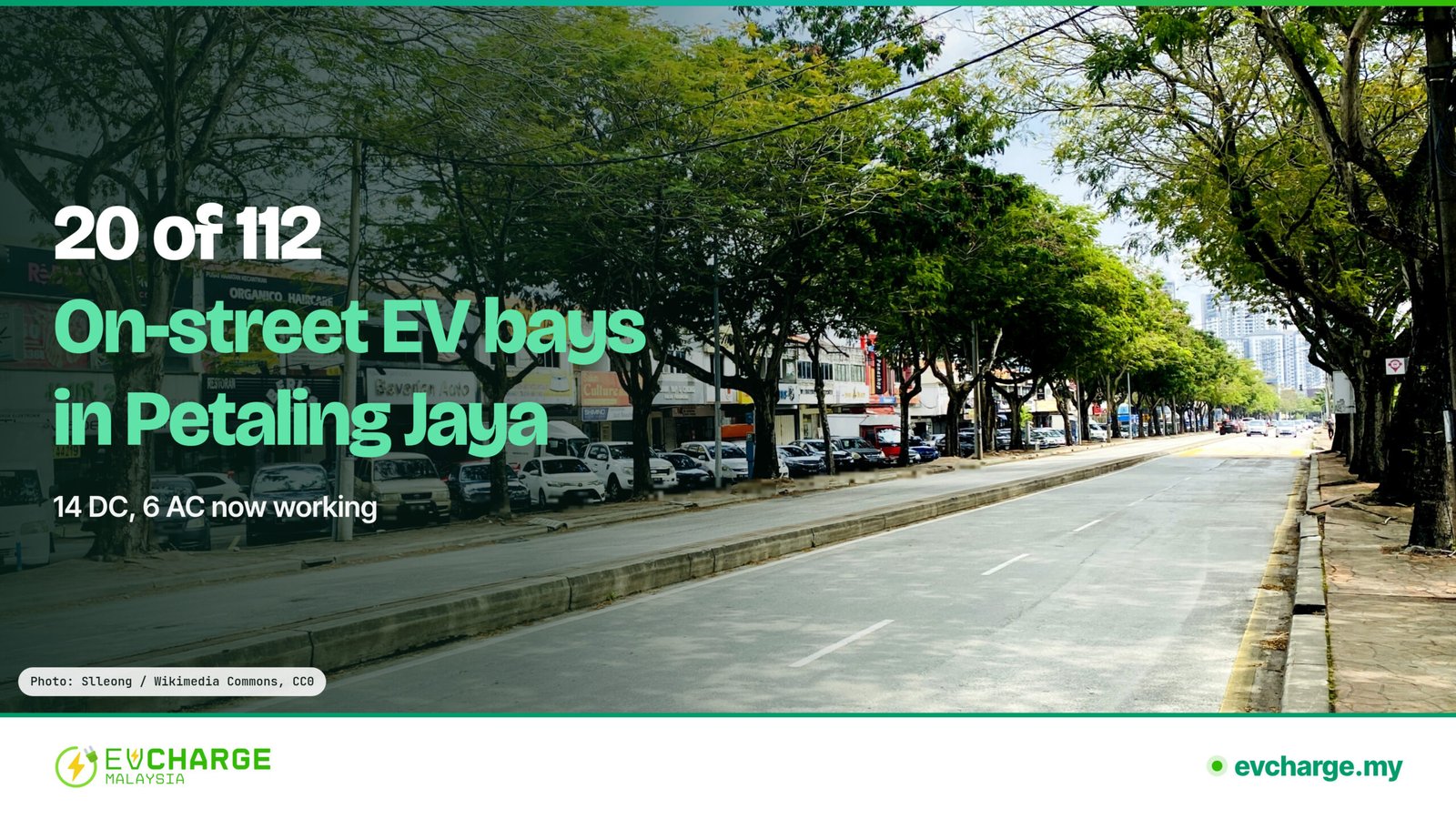
Summary: Petaling Jaya City Council (MBPJ) has approved 112 on-street EV charging bays, but only 20 were operational when Selangor exco Ng Sze Han gave the figures to the State Assembly on 16 November 2026. Kuala Langat has 21 council-linked charging units and Selayang has 4, while the other Selangor councils have none under their own management yet. A statewide EV charging master plan prepared by Shah Alam City Council (MBSA) is in its final stage, but no launch date has been given.
If you drive an EV in Petaling Jaya and can’t charge at home, the number that matters to you isn’t 112. It’s 20.
That’s how many of PJ’s approved on-street charging bays were operational as of 16 November 2026, based on figures Ng Sze Han (the state exco for investment, trade and mobility) gave at the Selangor State Assembly sitting that day. He was answering Rajiv Rishyakaran, the Bukit Gasing assemblyman, who asked for a council-by-council breakdown. It’s the clearest picture yet of Selangor EV charging bays run with local councils. The rollout is moving. Just not very fast.
Below you’ll find the count for every council, how much PJ has made from its EV bays, what the coming master plan is meant to fix, and what it all means if you drive an EV in Selangor. Our own view sits further down. Short version: the slow start worries us less than the fact that nobody has said when the other 92 bays will switch on.
How many on-street EV charging bays does each Selangor council have?
As of 16 November 2026, only three Selangor councils have on-street EV charging under their management: Petaling Jaya (20 operational out of 112 approved), Kuala Langat (21 units) and Selayang (4 units). Ng told the Assembly that the other local councils don’t operate any such facilities yet. For Kuala Langat and Selayang, the figures were given as units, and the Assembly reply did not confirm that all of them are fully operational.
“On-street” here means chargers in council parking bays by the roadside, not the ones inside malls, petrol stations or hotel car parks. Ng himself said urban charging is still mostly concentrated at malls and other commercial sites. For scale, he told the Assembly in April 2026 that Selangor had 1,090 EV charging bays statewide, with a target of 4,000 by 2030. That April figure is the statewide total, including mall and commercial sites, and it’s separate from the council-managed on-street bays we’re talking about here. It isn’t a November 2026 number.
| Council | On-street EV bays | What we know |
|---|---|---|
| Petaling Jaya (MBPJ) | 112 approved, 20 operational | 14 DC and 6 AC chargers running |
| Kuala Langat (MPKL) | 21 units | Run by JusEV Charging Network; council gets 5% of charging revenue. How many of the 21 are operational wasn’t stated |
| Selayang (MPS) | 4 units | No charges imposed yet; council said the facilities are not fully operational |
| Shah Alam, Ampang Jaya, Kuala Selangor, Hulu Selangor | None under council yet | Identifying sites with partners such as Worldwide Holdings Bhd |
| Sabak Bernam (MDSB) | None under council yet | Asked for chargers for weekend visitors; on-street sites identified |
Figures as given at the Selangor State Assembly sitting, 16 November 2026. The DC and AC split was given for PJ only.
Petaling Jaya: 112 approved, 20 operational
MBPJ has the biggest pipeline by far, with 112 on-street EV charging bays approved and 20 operational. Of those 20, 14 are DC fast chargers and 6 are AC chargers.
Quick explainer if those terms are new to you. A DC fast charger feeds power straight into your battery. A 20% to 80% top-up is often faster than AC, but the time varies with the charger’s power, the size of the battery, how much DC power your car can actually take, and the charging curve. AC is slower, same as the wallbox you’d have at home. Fine if you’re parking there a few hours anyway, like for work or a long makan. Practically every EV sold new in Malaysia today uses the Type 2 plug for AC, and most use CCS2 for DC, so plugging in shouldn’t be an issue at either.
So a 14-to-6 split in favour of DC is good news for people without home charging. A quick top-up while you makan lunch is far more useful at a street bay than a slow AC session.
MBPJ’s two main charging partners are JomCharge (run by EV Connection Sdn Bhd) and Carput Zap. The council signed an MoU with both on 26 June 2025, aiming for 1,000 chargers in two phases, with 500 in the first phase. That’s the partnership target, and it’s separate from the 112 on-street bays already approved and the 20 that are operational. Ng didn’t say which operator runs each of the 20 live bays.
Kuala Langat: 21 units with JusEV
Kuala Langat Municipal Council (MPKL) has 21 charging units, run under a profit-sharing arrangement with JusEV Charging Network, a local charge point operator. Ng told the Assembly that the council receives 5% of the charging revenue. He did not say how many of the 21 units are currently operational, so we aren’t treating all 21 as confirmed running.
You may see the name spelt “JuzEV” in some reports. The company’s own managing director is quoted as “JusEV Charging Network” in a Schneider Electric press release from April 2024, so JusEV is the correct spelling. And to be clear, JusEV is Kuala Langat’s partner, not PJ’s.
Selayang: 4 units, no fee yet
Selayang Municipal Council (MPS) has 4 units. They were counted among the councils that already have charging under their management, but the same Assembly figures also said the council hasn’t imposed charges yet because the facilities aren’t fully operational. So don’t count on these bays for your weekly charge yet. Some might not even be open to the public. That’s a temporary situation, not a policy.
The other councils: still looking for sites
Shah Alam (MBSA), Ampang Jaya (MPAJ), Kuala Selangor (MPKS) and Hulu Selangor (MPHS) have no on-street council chargers yet. They’re identifying new sites and working with industry players including Worldwide Holdings Bhd (WHB), the PKNS subsidiary the state has appointed to coordinate charge point operators in Selangor. WHB is also behind a separate plan with JomCharge for 1,000 chargers across Selangor.
Sabak Bernam District Council asked for more chargers for weekend visitors heading to Sekinchan and Sabak Bernam, and WHB has identified suitable on-street parking spots in the district. Ampang Jaya, Selayang, Hulu Selangor, Kuala Selangor and Sabak Bernam have all told the state that more charging is needed to keep up with growing EV ownership.
How much money has MBPJ made from its EV charging bays?
MBPJ collected RM99,330 between 1 January 2024 and 31 October 2026 from the rental and usage of council parking bays fitted with EV chargers.
Broken down, it looks like this. These are our own calculations, not official figures, and they’re rough historical averages over that 34-month period, not what the bays are earning now:
- The period covers 34 months, so it works out to roughly RM2,920 a month, or about RM35,000 a year.
- For comparison, MBPJ said in its Budget 2026 announcement (October 2025) that its 24-hour reserved parking bays for businesses would be rented out at RM400 a month. That isn’t a like-for-like comparison, because a reserved business bay and an EV charging bay are different arrangements. Still, the EV bay income over that period is roughly what seven of those reserved bays would bring in.
Before anyone reads too much into that, a caveat. The 20 operational bays weren’t all live for the full 34 months, and the Assembly figures don’t break down when each one started earning. Averaging the income as if they were would undersell the ones that have been busier or online longer. The figure also doesn’t tell us how many kWh were sold or how busy the bays are.
What is the Selangor EV charging master plan, and when will it launch?
The Selangor EV charging master plan is a statewide guide being prepared by Shah Alam City Council (MBSA). Ng said it’s in its final stage and that he’s confident it “will be launched soon”. No date was given.
The plan is meant to do three things: act as a reference for companies that want to install chargers, simplify the application process, and identify suitable locations.
Why does this matter? Back in April 2026, Ng told the Assembly that each council having its own application procedures had slowed down charger installations, and that the state had told MBSA to finalise one set of guidelines all councils could adopt. Separately, WHB is studying 500 new charging locations proposed by councils. That study is due for completion by mid-2027, which is a deadline for the study itself, not a date for 500 chargers to go live. The master plan is the piece that should make those approvals faster and more consistent.
Will Selangor subsidise EV charger installation?
No, not for now. The state says direct subsidies for installing charging stations aren’t currently necessary. Its focus is on simplifying applications, finding locations and helping operators get approvals from the relevant agencies.
This is about public charging stations built by operators. Nothing changes for your own home charger, which you still pay for. If you install one, use a competent electrical contractor registered with Suruhanjaya Tenaga (ST), and check the approvals that apply to your property, because they can vary.
What about EV charging in condos and strata homes in Selangor?
PLANMalaysia Selangor has prepared guidelines for strata developments that set out the proportion of parking bays that should be ready for EV charging. The exact percentage wasn’t given at the sitting.
Ng also told the Assembly in April 2026 that the state now requires new developments to include EV charging facilities. If you live in an existing condo, none of this will magically put a charger in your lot, but it gives you something concrete to raise with your JMB or management body.
Our view: 20 out of 112 is a slow start, but the missing timeline is the bigger problem
This section is EVCharge Malaysia’s opinion, not an official position or established fact.
As of 16 November 2026, about 18% of PJ’s approved on-street bays were operational (20 of 112). We think that’s a forgivable start. It doesn’t mean the project is 18% complete, because we don’t know how far along the other 92 bays are. The lack of any public date for those remaining bays is the part that isn’t forgivable.
Why should buyers care? Plenty of people in PJ live in older condos or terrace houses without a driveway, and for them the case for an EV rests on reliable public charging nearby. Approved bays with no switch-on date are hard to plan around. You can’t tell a would-be buyer in SS2 or Damansara Utama “there might be a DC charger on your street next year”.
The money tells a similar story. On our maths, PJ’s EV bays averaged about RM2,920 a month for the council over that historical period, roughly the rent from seven reserved bays, though as we said, that isn’t a like-for-like comparison. That’s not a criticism. Councils shouldn’t treat EV bays as cash machines, and a low fee to operators may be what gets chargers built. But it does mean revenue isn’t the measure to judge this programme by. Uptime and how many bays are live is.
And Kuala Langat, a much less urban district, already has 21 council-linked units on the books, against PJ’s 20 confirmed operational bays. We shouldn’t treat those as a straight comparison, because Ng gave Kuala Langat’s figure as 21 units without saying all of them are running. Even so, a smaller district being this far along still suggests the bottleneck in PJ isn’t only demand. Process and partner execution play a big part, which is exactly what the master plan is supposed to fix.
The case against our view
The strongest counter-argument is fair: approval always comes before construction. Each site needs power supply from TNB, civil works and an operator, and MBPJ’s MoU with its two main partners was only signed in June 2025. Judging it about 17 months in may be too early, and a jump in live bays during 2027 is quite possible. There’s also a decent argument that the state is right to skip subsidies. If operators are willing to fund the hardware themselves, public money is better spent elsewhere, and speeding up approvals costs the state much less.
What we’d do if we were buying an EV in PJ right now
If we lived in a PJ condo or a terrace house with no way to install a charger, we wouldn’t count those 92 approved bays as part of the deal yet. We’d plan around what’s live today: the 14 on-street DC chargers, plus whatever mall and petrol station chargers sit on our normal weekly routes.
Our own rule of thumb (opinion, not a standard): if there’s no working DC charger within about 10 minutes of where you live or work, try that routine for a couple of weeks before you sign, by renting or borrowing an EV if you can. It’s a cheap way to find out whether public charging fits your life before you commit to a car.
And if you can fit a home wallbox, we’d sort that out first and treat street bays as a backup. Charging at home on your TNB tariff usually costs less per kWh than public DC, and you’re never stuck waiting for a bay. Our EV charging cost calculator lets you compare the two for your own car.
Frequently asked questions
How many EV charging stations are there in Selangor?
Selangor had 1,090 EV charging bays statewide as of April 2026, according to the state government, and it’s targeting 4,000 by 2030. That broader statewide figure includes malls and other commercial sites, and it is separate from the council-managed on-street bays discussed in this article. It should not be read as a November 2026 total.
How many on-street EV charging bays does Petaling Jaya have?
MBPJ has approved 112 on-street EV charging bays, but only 20 were operational as of 16 November 2026. Of those 20, 14 are DC fast chargers and 6 are AC chargers.
Who operates the EV charging bays in Petaling Jaya?
MBPJ signed an MoU on 26 June 2025 with EV Connection (the company behind JomCharge) and Carput Zap Network to install EV chargers across the city, with a target of 1,000 chargers in two phases. That partnership target is separate from the 112 approved on-street bays and the 20 that are operational. Which operator runs each of the 20 live bays wasn’t stated at the Assembly sitting, so check the apps for specific locations.
Who runs the EV chargers in Kuala Langat?
Kuala Langat’s 21 council-linked charging units are run by JusEV Charging Network under a profit-sharing arrangement. The Kuala Langat Municipal Council receives 5% of the charging revenue. The Assembly figures did not say how many of the 21 units are operational.
When will the Selangor EV charging master plan be launched?
No date has been announced. On 16 November 2026, exco Ng Sze Han said the master plan prepared by Shah Alam City Council (MBSA) was in its final stage and would be launched soon.
Does Selangor give subsidies for EV charger installation?
Not at the moment. The Selangor government says direct subsidies for installing charging stations aren’t currently necessary. It’s focusing on simpler applications, finding sites and helping operators get approvals.
Figures are as stated at the Selangor State Assembly sitting on 16 November 2026. Charger locations, prices and availability change, so check the operator’s app before you go.