Charging an EV at home in Malaysia costs about 44 to 48 sen per kWh on TNB’s current domestic tariff (44.43 sen base, plus November’s 3.60 sen AFA), before the EEI rebate, 1.6% KWTBB and any SST. A full 60 kWh charge at home works out to roughly RM27 to RM29 (60 × RM0.4443 to RM0.4803). Public AC usually runs about RM1.00 to RM1.15 per kWh and DC fast charging typically RM1.30 to RM1.80, so the same 60 kWh costs around RM60 on AC and RM78 to RM108 on DC, memang jauh beza. Plug in your own numbers with our EV charging cost calculator or see our full EV vs petrol comparison.
Let’s talk about something we selalu kena fikir nowadays: how much does it really cost to charge an EV in Malaysia? If you’re planning to jump from petrol to electric, sure lah you want to know what’s the real deal. If you’re thinking whether to switch, can or not, this is for you.
Want the full breakdown? We compare home charging, public AC and DC fast charging against RON95, with and without BUDI95, in our EV vs petrol cost guide.
Comparing Petrol And EV Charging
First, petrol price. As of 15 Oct 2026, eligible Malaysians pay RM1.99 per litre for RON95 under BUDI95, with a monthly quota of 300 litres. Not eligible? Then you pay the unsubsidised price, which changes every week (it was RM4.62 per litre for 15 to 21 Oct 2026, source: MOF). So if you’re driving a normal sedan, maybe, like a Proton Saga, full tank about 40 litres, you’re looking at RM79.60 for a full tank at RM1.99, or RM184.80 at RM4.62. That’ll give you around 500 kilometres if you drive like a normal person.
For an EV, the calculation is a bit different.
| Item | Details |
|---|---|
| Popular EV Models | BYD Atto 3, Ora Good Cat |
| Battery Capacity | 50 – 64 kWh |
| TNB home (energy + capacity + network) | 44.43 sen per kWh (before AFA, EEI, KWTBB, SST) |
| Cost for Full Charge (60 kWh) | ~RM27 to RM29 |
| Range per Full Charge | 400 – 500 km |
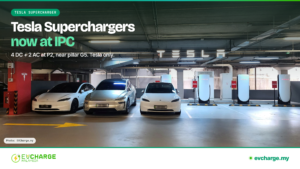
Public charging are already catching up all over the country. You’ll see some charging stations in malls or highway R&R. Public AC is usually about RM1.00 to RM1.15 per kWh, while DC fast chargers typically run about RM1.30 to RM1.80 per kWh. Rates vary by network and time of day, for example the Tesla Supercharger at IPC Mutiara Damansara was listed from RM0.69/kWh overnight to RM1.07/kWh during the day. You want your EV to charge quick, mesti bayar lebih lah. If you use these chargers for a full 60kWh top-up, it will cost about RM78 to RM108 each time. Can be about the same as petrol if you always use fast charging.
So, if you can charge at home, you save a lot. If you depend on public fast charging? The cost is almost like petrol. That’s the main point.
Want the full breakdown? We compare home charging, public AC and DC fast charging against RON95, with and without BUDI95, in our EV vs petrol cost guide.
What Decides The EV Charging Cost?
There are a few things that will affect how much you pay for charging:
- Where you charge: Home, shopping mall, or highway.
- Type of charger: AC is slower and cheaper, DC is faster but costs more.
- Your battery size: Bigger battery = more RM to charge.
- Charging habits: Always top-up or always wait until kosong?
If you’re the type always rushing, only using DC fast chargers, then, memang mahal sikit lah. But if you can plug in every night at home, you’re looking at major savings.
Is It Cheaper In The Long Run?
If you often use your car daily and can charge at home, you’ll save money in the long term. RM29 per week for charging versus RM80 for petrol is a nice gap. That’s more cashback for kopi atau teh tarik, right? If you’re not on BUDI95 and paying the unsubsidised price, the gap is even bigger. We ran the full numbers in our EV vs petrol cost comparison. Want to see your own numbers? Try our EV charging cost calculator.
But you have to think of the upfront EV price. Most EVs are still pricier than petrol cars. Over time, those charging savings will add up, but you have to plan for the long haul.
FAQ: Malaysia EV Charging
1. How much does it cost to charge an EV at home?
On average, you’ll pay about RM27 to RM29 for a full 60 kWh charge at home, based on TNB’s 44.43 sen base rate plus AFA. KWTBB, SST above 600 kWh and the EEI rebate shift the final bill a bit.
2. Is public charging much more expensive?
Yes, public fast chargers are more expensive. Expect to pay about RM1.30 to RM1.80 per kWh on DC, and around RM1.00 to RM1.15 on AC. A full charge can be as high as RM108 if you use fast DC chargers every time.
3. Can I only charge at home?
As long as your home has the proper electrical setup, you can charge your EV at home with a dedicated wallbox or even a regular 3-pin plug. But charging is slower if you use the normal plug.
4. Is EV charging still cheaper than petrol with the new RM1.99 price?
If you charge at home, yes, it’s cheaper than petrol. RM29 for 400 kilometres versus RM80 for petrol for around 500 kilometres. But if you’re always using fast chargers on the road, then sometimes the cost is almost the same as filling up with RON95.
5. Does charging speed matter for cost?
Yes. Fast chargers (DC) work quickly, but you pay more. If you’re not in a rush and can leave your car charging overnight with an AC charger, you’ll pay much less.
6. Will EV charging get even cheaper?
Maybe, but right now, electricity tariffs are still controlled. If more Malaysians start using EVs and TNB keeps prices stable, charging could stay affordable. But always check for any new government updates.
The Bottom Line
If you want to save on running costs and can charge at home, EVs make sense. Petrol is a bit more predictable, especially with BUDI95 at RM1.99 if you’re eligible. But with electricity, you get flexibility. In the end, it’s about your lifestyle. Always on the go, always on highways? Maybe petrol is easier for now. Can plug in at night, relax, then go to work in the morning? EV sure can save.
That’s the story lah. Think about what’s most practical for your daily life and whether you can handle the “plug-in” habit. In Malaysia, got options for both, up to you, can or not?