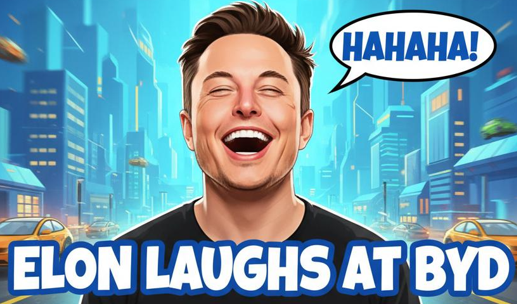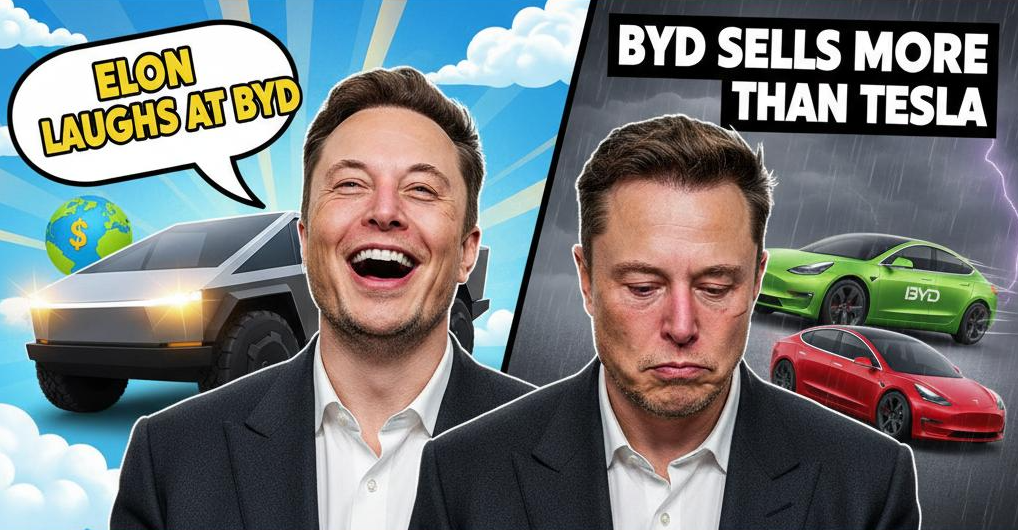
Remember this video from 2011? Elon Musk literally laughed when asked about BYD as a competitor. Watch it here:
Well, guess who’s laughing now?
The EV scene in Europe is getting really interesting right now. Tesla, the one everyone thought was untouchable, is actually struggling big time while Chinese brands are swooping in and taking over.
Tesla’s sales dropped by 43.5% in the first seven months of 2025 compared to last year. That’s like… wow, right? And in July alone, they sold 42.4% fewer cars.
While Tesla is struggling, Chinese brand BYD is absolutely crushing it. BYD tripled their sales, growing by more than 250% in the first seven months of 2025. In July, BYD even grabbed 1.1% market share, beating Tesla’s 0.7%.
What’s Really Going On in Europe?
The whole European EV market is still growing lah. Battery electric vehicles now make up 15.6% of new car registrations in the EU, compared to just 12.5% last year. So people are definitely buying more EVs, just not Tesla ones.
Looking at the numbers across Europe:
- Germany saw EV sales jump 35% – 38%
- Spain had a crazy 83% increase
- Italy grew up to 82% in 2025. (source)
- UK increased by 31%
- Only France dropped by 4.3%
| Country | EV Sales Change |
|---|---|
| Spain (had a crazy increase) | +83% |
| Germany | +35% |
| UK | +31% |
| Italy | +29% |
| France | -4.3% |
Chinese Brands Are Killing It
BYD isn’t the only Chinese company making waves. SAIC Motor, which owns brands like MG, grabbed 1.9% market share after their sales jumped over 30%.
What makes these Chinese brands so attractive? Simple. They’re offering similar technology at much better prices. Plus, they have way more model choices than Tesla’s limited lineup.
Why Is Tesla Struggling?
Here’s the thing about Tesla. They’ve always positioned themselves as premium, right? But now you have Chinese brands offering similar features for less money. When people can get almost the same thing for cheaper, why wouldn’t they switch?
The report mentions something interesting too. Tesla’s troubles started around the time CEO Elon Musk got involved in US politics and joined the government. Maybe European buyers don’t like mixing cars with politics? Just saying.
Why Europeans Are Choosing Chinese EVs Over Tesla
It’s not just about price, though that’s a big part of it. Chinese brands are actually delivering better value in ways that matter to everyday drivers.
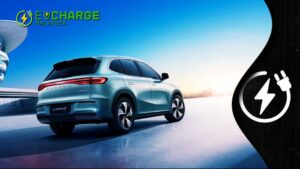
Take the BYD Atto 3, for example. This compact SUV costs around €38,000 (RM181,000) in Europe, which is way cheaper than a Tesla Model Y that starts at €47,000 (RM224,000). But here’s the thing, the Atto 3 isn’t just cheap, it’s actually good.
The Atto 3 gives you a 420km range, which is pretty decent for most people’s daily driving. It charges from 30% to 80% in just 29 minutes. Compare that to Tesla’s Model Y, which sure, has longer range, but costs nearly €10,000 (RM48,000) more.
But it’s not just BYD. Look at MG4, another Chinese car that’s doing really well in Europe. It starts at around €31,000 (RM148,000) and gives you 350km range. For many Europeans, that’s more than enough for their daily commute and weekend trips.
Chinese brands also get what people actually need. You get heated seats without paying extra. The interiors feel nicer too, not like Tesla where everything’s all minimalist and sometimes feels a bit cheap for the price you pay.
And here’s something that really matters, warranty coverage. BYD gives you 6 years on the car itself, 8 years on the battery. Tesla? Standard warranty is much shorter. When you’re spending this much money, you want that peace of mind lah.
What’s Next?
With over 1,000 EV models expected by 2026, the competition is only going to get fiercer. Tesla needs to adapt fast, or they might find themselves becoming a niche luxury brand instead of the mass market leader they once were.
For consumers, this competition is fantastic news. Better cars, better prices, and more choices. That’s what happens when the market gets competitive, bah.
The European market is basically showing us the future. Traditional big names can’t just coast on their reputation anymore. They need to keep innovating and offer real value, or someone else will take their customers.
FAQ
Q: Why are Chinese EV brands suddenly so popular in Europe?
A: They’re offering similar technology to Tesla but at lower prices. Plus, they have more model variety and are innovating fast with features like advanced charging systems.
Q: Is Tesla still worth buying compared to Chinese alternatives?
A: Depends on what you value. Tesla still has strong brand recognition and their Supercharger network. But Chinese brands often give you more bang for your buck.
Q: Will this trend continue or is it just temporary?
A: The numbers suggest it’s a real trend. Chinese manufacturers are investing heavily in European markets and consumers seem to like what they’re offering.
Q: How does this affect EV prices in Malaysia?
A: More global competition usually leads to better prices everywhere. As Chinese brands expand internationally, they often bring competitive pricing to all markets including Malaysia.